
KHUN KHAN PILOT
Taking the prototype into the field.
Khun Khan National Park · Mae Sap, Samoeng, Chiang Mai, Thailand
PURPOSE & PARTICIPANTS
A field setting.
Practical perspectives.
Bring the prototype into the environment that inspired it and learn from the people working there.
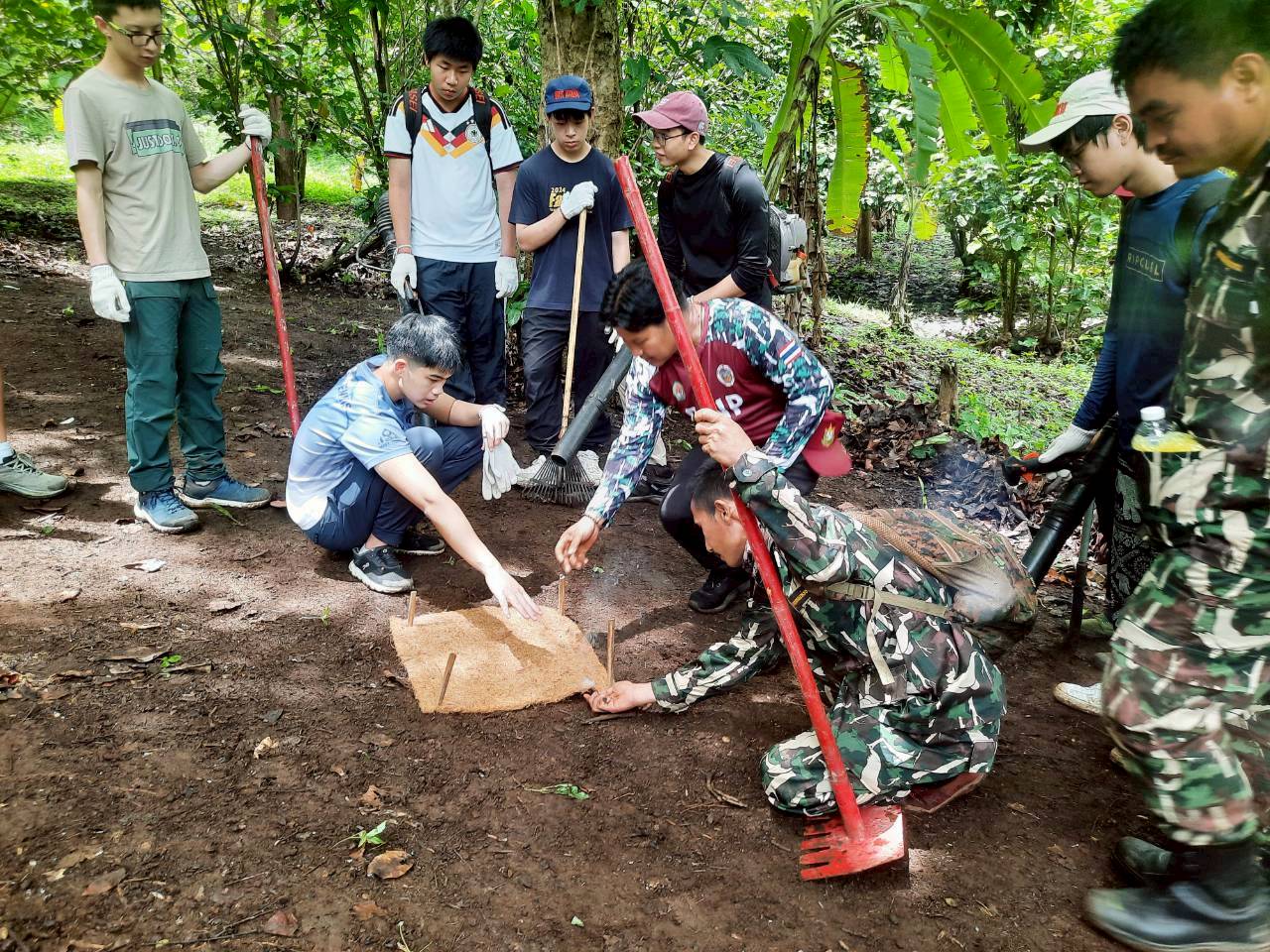
The visit brought the coated coconut coir prototype to Khun Khan National Park to explore its handling and placement, observe preliminary fire demonstrations, and gather feedback from park personnel.
People behind the visit
Tul Sosothikul, founder and student researcher at KAOMA Labs, led the materials research and prototype development, including laboratory testing at KMUTT. He participated in the field pilot alongside team members and Khun Khan park personnel, who managed the fire and safety and provided practical feedback.
PHOTOGRAPHS FROM KHUN KHAN
Field pilot in photographs.
ORIGINAL FIELD VIDEOS
Watch the field activities.
Khun Khan National Park · 6 June 2026
Four original recordings from the pilot.
Short recordings from the preliminary field pilot at Khun Khan National Park.
Positioning the Prototype
Placing the coated coir mat on cleared ground before the demonstration.
Open original videoFlame Exposure on Bare Soil
Park personnel expose the prototype to a flame while it rests on bare soil.
Open original videoCovering Burning Material
Placing the prototype over a small burning pile. This demonstrates covering burning material, not a pre-positioned firebreak.
Open original videoAfter the Demonstration
A closer look at the prototype immediately after fire exposure.
Open original videoThese informal demonstrations had no matched untreated control, and fuel, airflow, and flame strength were not controlled. Covering burning material may physically smother flames. The recordings do not establish wildfire effectiveness or replace controlled material testing.
RANGER FEEDBACK
Listening to the Rangers.
Conversations with rangers highlighted practical considerations including terrain, response time, mat size, and coverage. Their feedback helped clarify the challenges of handling and deploying the mats in the field.
Read interview summary
Forest Ranger Interview Summary
English summary of the Thai-language interview, from the project interview document.
- Interview date
- 6 June 2026
- Location
- Khun Khan National Park, Mae Sap Subdistrict, Samoeng District, Chiang Mai Province, Thailand
- Interviewees
- Khun Khan National Park rangers; names withheld for safety and operational reasons
- Prototype discussed
- A 50 × 50 cm flame-retardant-coated coconut coir mat
1. Potential Strengths and Suitable Use Cases
- The rangers thought the prototype potentially more suitable for flat terrain, where the mat could be positioned more securely.
- Based on the preliminary field demonstration, the prototype appeared more suitable for small, early-stage fires than for large or established fire fronts.
- During the demonstration, visible fire did not continue to spread across the entire mat, while the areas exposed to heat and flame became charred.
- The rangers suggested that the mat could potentially be placed over a small, localized burning area during the early stage of a fire.
2. Limitations and Operational Challenges
- Actual forest terrain is frequently uneven and may include rocks, grass, and steep areas. Under these conditions, the mat may not lie flat and could shift or be displaced by wind.
- The 50 × 50 cm prototype was considered too small for operational use. The rangers also indicated that a proposed 1 × 12 m configuration might provide insufficient coverage because a conventional firebreak is about 8 m wide.
- The rangers reported that hotspot information may not be received until 7:00 a.m. Preparation and travel to the affected area may take two additional hours.
- By the time the rangers arrive, the fire front may spread significantly wider and be more difficult to control, reducing the practical usefulness of a small mat-based system.
- If the mat were placed as a linear firebreak, flames, embers, or the wider fire front might pass around or across the barrier.
3. Additional Suggestions
- The rangers suggested exploring a concentrated liquid version of the flame-retardant formulation that could be transported in a container, diluted with water in the field, and potentially applied by spraying, including in situations involving fire on trees or elevated vegetation.
CURRENT
Community use.
A local community has adopted the mats for small-fire use. This is their current application; their effectiveness in slowing wildfire spread has not been established.